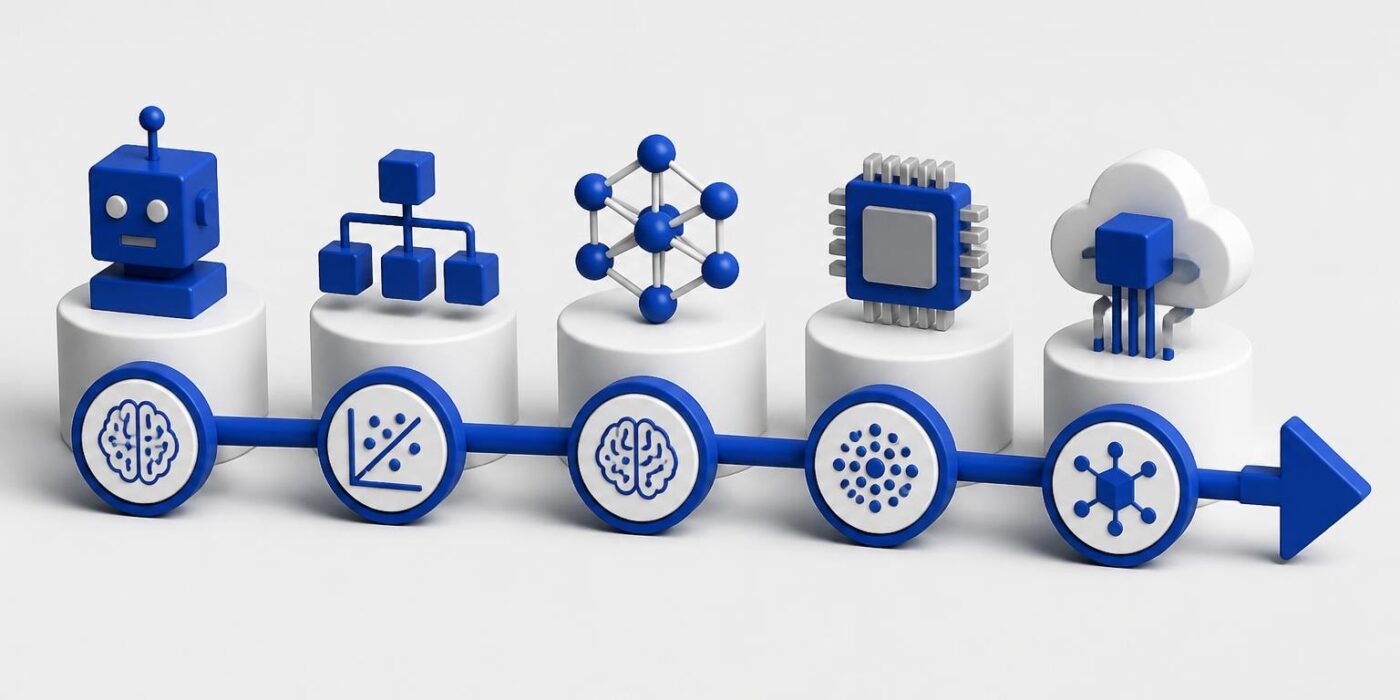
The development of artificial intelligence has transformed from theoretical mathematics into production-ready APIs that power millions of applications. Understanding this evolution isn't just academic history. It shapes how you architect systems, choose tools, and predict where AI is heading. This article walks through the technical progression of AI development, examines key architectural shifts, and shows you how to leverage modern AI tools in your projects today.
From Theory to Code: Early Foundations
The development of artificial intelligence began with Alan Turing's 1950 paper "Computing Machinery and Intelligence," which proposed the famous Turing Test. This wasn't abstract philosophy. Turing asked a practical question: can machines exhibit intelligent behavior indistinguishable from humans?
The Dartmouth Summer Research Project in 1956 officially launched AI as a field. John McCarthy, Marvin Minsky, Claude Shannon, and Nathan Rochester gathered researchers to explore machine learning, neural networks, and symbolic reasoning. They believed intelligent machines were achievable within a generation.

Symbolic AI and Expert Systems
Early AI focused on symbolic reasoning. Programs like Logic Theorist (1956) and General Problem Solver (1957) manipulated symbols to prove mathematical theorems. These systems used explicit rules and formal logic.
Key characteristics of symbolic AI:
- Hand-coded knowledge bases
- Rule-based inference engines
- Deterministic outputs
- Brittle performance outside narrow domains
LISP, created by John McCarthy in 1958, became the dominant AI programming language. Its support for symbolic computation, recursion, and dynamic typing made it ideal for AI research. You'll still see LISP influences in modern functional programming patterns used for AI workflows.
Expert systems dominated the 1970s and 1980s. MYCIN (1972) diagnosed blood infections. DENDRAL identified molecular structures. These systems encoded domain expertise as IF-THEN rules. They worked but required extensive manual knowledge engineering.
The development of artificial intelligence hit its first major wall when expert systems couldn't scale. Building and maintaining thousands of rules became impractical. The "knowledge acquisition bottleneck" slowed progress significantly.
The Statistical Revolution
Machine learning shifted AI from rules to data. Instead of programming intelligence, systems learned patterns from examples. This fundamentally changed how developers approached AI problems.
Perceptrons, introduced by Frank Rosenblatt in 1958, were early neural networks. They could learn simple patterns but struggled with non-linear problems. Marvin Minsky and Seymour Papert's 1969 book "Perceptrons" highlighted these limitations, contributing to reduced AI funding known as the "AI Winter."
Backpropagation and Neural Network Renaissance
The backpropagation algorithm, popularized in the 1980s, enabled training of multi-layer neural networks. Geoffrey Hinton, David Rumelhart, and Ronald Williams demonstrated how to efficiently calculate gradients through network layers.
| Era | Approach | Key Technique | Limitation |
|---|---|---|---|
| 1950s-1970s | Symbolic AI | Rule-based logic | Knowledge bottleneck |
| 1980s-1990s | Expert Systems | IF-THEN rules | Couldn't generalize |
| 1990s-2010s | Machine Learning | Statistical models | Required feature engineering |
| 2010s-Present | Deep Learning | Neural networks | Needs massive data |
Support Vector Machines (SVMs) and decision trees provided practical alternatives to neural networks through the 1990s and early 2000s. These algorithms powered spam filters, recommendation systems, and image classifiers with less computational overhead.
Random forests, boosting algorithms like AdaBoost, and ensemble methods dominated practical AI applications before deep learning took over. Many production systems still use these algorithms for structured data problems.
Deep Learning Era
The development of artificial intelligence accelerated dramatically after 2012. AlexNet's victory in the ImageNet competition demonstrated that deep convolutional neural networks could outperform traditional computer vision approaches.
Critical enabling factors:
- GPU acceleration (CUDA programming)
- Large labeled datasets (ImageNet, Common Crawl)
- Better optimization algorithms (Adam, RMSprop)
- Regularization techniques (dropout, batch normalization)

TensorFlow (2015) and PyTorch (2016) democratized deep learning. You could build and train complex neural networks without implementing backpropagation from scratch. These frameworks abstracted low-level operations while maintaining flexibility.
Transformer Architecture Revolution
Attention mechanisms and the transformer architecture (2017) changed everything. "Attention Is All You Need" introduced a model that processed sequences in parallel rather than sequentially. This architectural shift enabled training on massive datasets.
BERT (2018) showed bidirectional context understanding. GPT-2 (2019) demonstrated few-shot learning capabilities. GPT-3 (2020) proved that scaling model parameters and training data produced emergent abilities.
The path to artificial general intelligence (AGI) remains uncertain, but transformers provided architectural foundations that scale effectively. Modern AI systems build on this transformer base with different training objectives and fine-tuning strategies.
Building with Modern AI APIs
The development of artificial intelligence has reached a practical inflection point for developers. You don't need research teams or GPU clusters to integrate AI into production applications. API-first AI services handle model training, hosting, and inference.
Major API providers and their strengths:
- OpenAI – GPT-4 for general language tasks, embeddings, image generation
- Anthropic – Claude for long-context understanding and safety
- Google – Gemini for multimodal inputs, PaLM for efficiency
- Cohere – Enterprise-focused NLP with customization options
- Hugging Face – Open-source models and deployment infrastructure
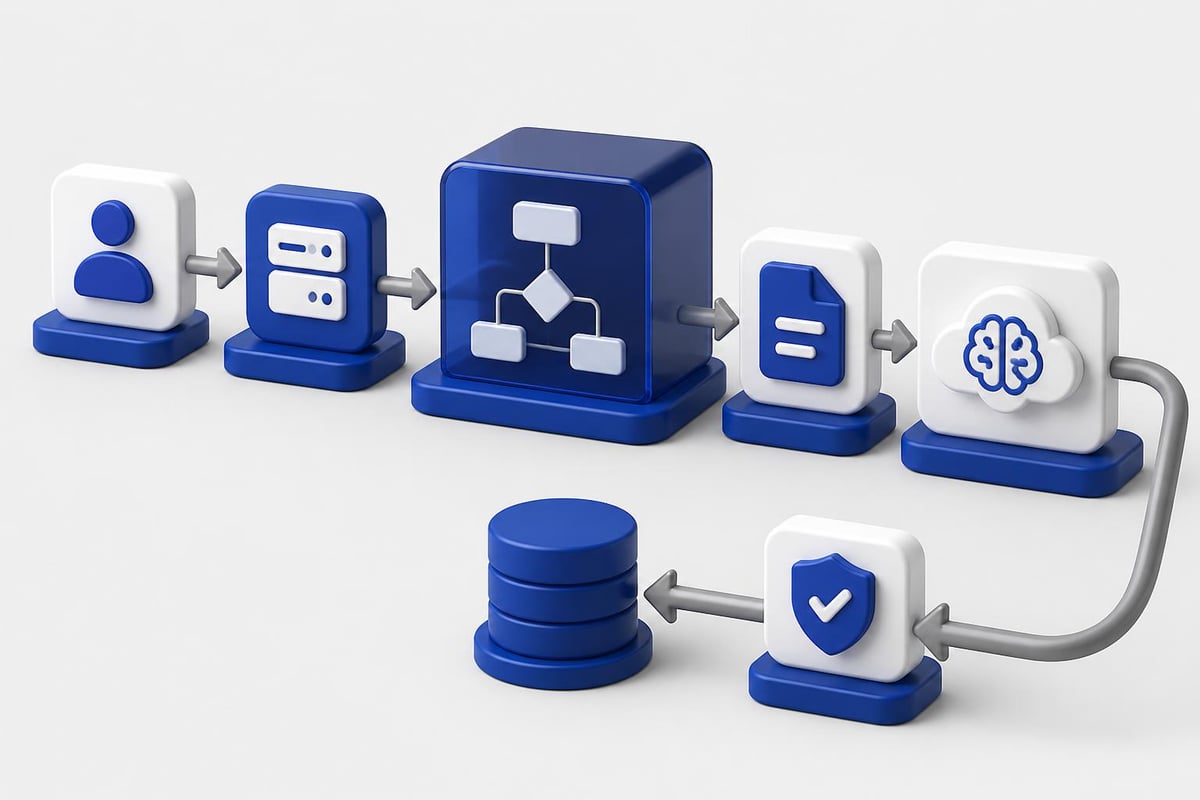
These APIs abstract model complexity. You send HTTP requests with text prompts and receive structured responses. The heavy lifting of model training, optimization, and deployment happens server-side.
API Integration Patterns
Modern AI development follows specific integration patterns. Understanding these patterns helps you build robust, scalable applications.
# Basic completion pattern
POST https://api.openai.com/v1/chat/completions
{
  "model": "gpt-4",
  "messages": [
    {"role": "system", "content": "You are a code reviewer."},
    {"role": "user", "content": "Review this Python function: def calc(x): return x*2"}
  ],
  "temperature": 0.3
}
Core integration patterns:
- Direct completion – Send prompt, receive response
- Streaming – Get tokens as they generate for better UX
- Function calling – Let models trigger your API endpoints
- Embeddings – Convert text to vectors for semantic search
- Fine-tuning – Adapt base models to your specific domain
Prompt engineering became a critical skill. The development of artificial intelligence shifted from training models to crafting effective instructions. Temperature, top_p, frequency_penalty, and presence_penalty parameters control output randomness and repetition.
Production Considerations
Deploying AI features requires different thinking than traditional software. Models are probabilistic, not deterministic. Outputs vary even with identical inputs. This creates unique challenges.
Production implementation checklist:
- Rate limiting and quota management
- Response validation and sanitization
- Fallback strategies when API calls fail
- Cost monitoring and budget alerts
- Caching for repeated queries
- User feedback collection for improvement
For developers looking to master these patterns systematically, building real production projects provides the best learning path. The AI Developer Certification (Mammoth Club) teaches integration of OpenAI, Claude, and modern AI APIs into production-ready software through hands-on projects covering prompt engineering, backend workflows, and deployment.

Error Handling and Reliability
AI APIs fail differently than traditional endpoints. Models might refuse requests, exceed context limits, or generate unusable outputs. Your error handling must account for these scenarios.
| Error Type | Cause | Solution |
|---|---|---|
| Rate limit | Too many requests | Implement exponential backoff |
| Context overflow | Input too long | Chunk input or summarize |
| Refusal | Safety filters triggered | Rephrase prompt or add context |
| Timeout | Model taking too long | Set appropriate timeouts, retry logic |
| Invalid output | Model doesn't follow format | Use structured output modes or validation |
Token counting matters for both cost and context management. Different models have different tokenization schemes. OpenAI's tiktoken library helps calculate tokens before API calls. Budget accordingly, as costs scale with input and output tokens.
The history of AI development shows repeated cycles of hype and disappointment. Current transformer-based systems have real limitations. They hallucinate facts, struggle with arithmetic, and can't truly reason about causality.
Specialized AI Systems
General-purpose language models dominate attention, but specialized AI systems often perform better for specific tasks. Computer vision, speech recognition, and recommendation systems use domain-specific architectures.
Computer Vision Applications
Convolutional Neural Networks (CNNs) remain the backbone of image processing. YOLO and R-CNN architectures detect objects in real-time. Semantic segmentation models label every pixel in an image.
Common vision tasks and approaches:
- Image classification – ResNet, EfficientNet architectures
- Object detection – YOLOv8, Faster R-CNN
- Semantic segmentation – U-Net, DeepLab
- Face recognition – FaceNet, ArcFace
- Image generation – Stable Diffusion, DALL-E
APIs like Roboflow and Clarifai provide hosted computer vision capabilities. You upload images, call endpoints, and receive predictions. This follows the same pattern as language model APIs but for visual data.
Embedding Models and Semantic Search
Vector embeddings transformed how applications handle search and similarity. Models convert text into high-dimensional vectors where semantic similarity corresponds to geometric proximity.
The development of artificial intelligence in search moved from keyword matching to semantic understanding. You can find documents about "car maintenance" when users search for "vehicle repair" because embeddings capture meaning, not just words.
Embedding workflow:
- Generate embeddings for your document corpus
- Store vectors in specialized databases (Pinecone, Weaviate, Qdrant)
- Convert user queries to embeddings
- Find nearest neighbors using cosine similarity
- Return relevant documents
This powers recommendation systems, duplicate detection, and contextual search. Many AI software development projects combine embeddings with large language models for retrieval-augmented generation (RAG).
Training Your Own Models
While APIs handle most use cases, some applications require custom models. Training from scratch is expensive and time-intensive. Fine-tuning pre-trained models offers a middle ground.
Training approaches ranked by resource requirements:
- Prompt engineering – Zero training, lowest cost
- Few-shot learning – Include examples in prompts
- Fine-tuning – Adapt existing models to your data
- Training from scratch – Full control, maximum resources
Transfer learning leverages models pre-trained on massive datasets. You start with weights from BERT, GPT, or ResNet and continue training on your specific task. This requires far less data and compute than training from random initialization.
Hugging Face Transformers library provides pre-trained models and training scripts. You can fine-tune models for classification, named entity recognition, question answering, or summarization with relatively modest hardware.
Data Requirements and Quality
The development of artificial intelligence is fundamentally data-driven. Model performance depends heavily on training data quality and quantity.
| Task | Minimum Examples | Recommended | Quality Requirements |
|---|---|---|---|
| Classification | 100-500 per class | 1,000-10,000 | Balanced classes, clear labels |
| Named Entity Recognition | 500-1,000 | 5,000-20,000 | Consistent annotation, diverse examples |
| Text Generation | 1,000-5,000 | 100,000+ | Coherent, representative samples |
| Image Classification | 100-500 per class | 1,000-10,000 | High resolution, varied backgrounds |
Data labeling consumes significant time and budget. Tools like Label Studio, Prodigy, and Amazon SageMaker Ground Truth streamline annotation workflows. Active learning strategies identify which examples most need human labels.
AI Infrastructure and MLOps
Production AI systems require infrastructure beyond traditional web applications. Model versioning, experiment tracking, and automated retraining create new operational challenges.
Core MLOps components:
- Experiment tracking – MLflow, Weights & Biases for recording training runs
- Model registry – Centralized storage with versioning
- Feature stores – Consistent features across training and inference
- Monitoring – Track prediction accuracy and data drift
- CI/CD pipelines – Automated testing and deployment
The development of artificial intelligence operations (MLOps) mirrors DevOps evolution. You need reproducible environments, automated testing, and gradual rollouts. Unlike traditional software, model performance can degrade over time as real-world data shifts.
Monitoring production models means tracking metrics beyond traditional application performance. Prediction latency matters, but you also monitor prediction distributions, input data statistics, and accuracy on validation sets.
Deployment Strategies
Different deployment patterns suit different use cases. Real-time APIs, batch processing, and edge deployment each present trade-offs.
Deployment options comparison:
- Hosted API – Simplest, highest per-request cost, vendor lock-in
- Self-hosted model – Full control, infrastructure management required
- Edge deployment – Low latency, offline capability, limited model size
- Batch processing – Cost-efficient for non-real-time tasks
Container-based deployment with Docker and Kubernetes provides flexibility. You package models with their dependencies, deploy to any cloud provider, and scale based on traffic. FastAPI and Flask create lightweight Python web services around model inference code.
Modern frameworks discussed in research on AI programming languages evolution show how language choice impacts development velocity and runtime performance. Python dominates AI development, but production systems increasingly use Rust or Go for serving layers.
Ethical and Safety Considerations
The development of artificial intelligence brings responsibility. Models can perpetuate biases present in training data, generate harmful content, or be used for deception.
Key safety mechanisms:
- Content filtering on inputs and outputs
- Rate limiting to prevent abuse
- Human-in-the-loop verification for high-stakes decisions
- Adversarial testing to find failure modes
- Bias audits across demographic groups
- Clear disclosure when users interact with AI
Frameworks for assured AI development emphasize verification, validation, and ongoing monitoring. This matters especially for applications in healthcare, finance, or criminal justice where errors have serious consequences.
Red-teaming exercises systematically test model vulnerabilities. You try to make the model generate harmful outputs, reveal training data, or bypass safety guardrails. Finding these issues before deployment prevents real-world harm.
Future Directions
The development of artificial intelligence continues accelerating. Several trends shape where the field is heading and what developers should prepare for.
Emerging capabilities to watch:
- Multimodal models processing text, images, audio, and video simultaneously
- Longer context windows enabling whole-codebase understanding
- Improved reasoning through chain-of-thought and self-reflection
- Smaller, more efficient models that run locally
- Better integration between symbolic AI and neural networks
Research into comprehensive AI development frameworks shows increasing focus on systematic design, development, and deployment processes. As AI becomes more powerful, structured engineering practices become critical.
The gap between research and production continues narrowing. Papers published in 2026 often include public model releases and API access. Open-source communities like Hugging Face accelerate the transition from academic research to deployed applications.
For developers, staying current means following model releases, testing new capabilities, and understanding architectural improvements. The fundamentals of good software engineering, API design, and user experience remain essential regardless of which AI capabilities you integrate.
Tools for tracking AI research publications help developers identify relevant advances among thousands of papers published annually. Following key researchers, conferences like NeurIPS and ICML, and implementation blogs provides practical knowledge.
Integration Patterns for Common Use Cases
Practical implementation requires understanding which AI capabilities fit which problems. Not every application needs GPT-4. Matching tools to requirements optimizes both cost and performance.
Use case to AI approach mapping:
| Use Case | Best Approach | Example Tools |
|---|---|---|
| Content generation | Large language models | GPT-4, Claude |
| Code completion | Code-trained models | GitHub Copilot, Codex |
| Customer support | Fine-tuned chatbots | Custom GPT, Rasa |
| Document search | Embeddings + vector DB | OpenAI Embeddings, Pinecone |
| Image classification | CNN or vision API | ResNet, Google Vision API |
| Sentiment analysis | Small classification model | BERT fine-tuned, DistilBERT |
Developers working on AI-based projects benefit from understanding multiple approaches. Sometimes a simple rule-based system outperforms neural networks for structured problems. The best solution balances accuracy, latency, cost, and maintainability.
Chain-of-thought prompting improves reasoning on complex tasks. Instead of asking for a direct answer, you prompt the model to think step-by-step. This technique emerged from research but applies directly to production applications.
Function calling transforms language models into application controllers. Models decide when to call your functions, what parameters to pass, and how to use returned data. This creates natural language interfaces to existing APIs and databases.
The development of artificial intelligence has progressed from theoretical concepts to practical APIs that developers integrate daily. Understanding this evolution helps you make better architectural decisions, choose appropriate tools, and anticipate where AI capabilities are heading. Whether you're building chatbots, adding semantic search, or automating code reviews, modern AI tools provide production-ready solutions. Start building real projects with AI Code Central to master prompt engineering, backend integration, and deployment workflows that turn AI capabilities into shipped features.