
Modern artificial intelligence has fundamentally changed how developers build software. What began as academic research into neural networks and statistical models has transformed into a production-ready toolkit that powers everything from recommendation engines to code generation. For developers in 2026, understanding modern artificial intelligence isn't about mastering abstract theory. It's about knowing which APIs to call, how to structure prompts, and when to fine-tune versus when to use zero-shot inference. This shift from research to engineering means practical implementation matters more than ever.
What Defines Modern Artificial Intelligence
Modern artificial intelligence refers to systems built on deep learning architectures that can process unstructured data at scale. Unlike rule-based systems from earlier decades, these models learn patterns from massive datasets and generalize to new inputs.
The defining characteristics separate modern approaches from traditional machine learning:
- Transformer architectures that process sequences in parallel rather than sequentially
- Pre-trained foundation models that transfer knowledge across tasks
- API-first deployment enabling developers to integrate AI without training infrastructure
- Multimodal capabilities processing text, images, audio, and video in unified systems
- Few-shot learning requiring minimal examples to adapt to new domains
These technical shifts matter because they change how you build applications. Instead of collecting thousands of labeled examples and training custom models, you can now leverage AI for programming tasks through API calls with carefully designed prompts.

Core Technologies Behind Modern Systems
The Annotated History of Modern AI and Deep Learning traces how specific innovations enabled today's capabilities. Transformers replaced recurrent networks as the dominant architecture starting in 2017. Self-attention mechanisms allow models to weigh the importance of different input elements dynamically, making them more effective at capturing long-range dependencies.
Pre-training changed economics. Rather than training models from scratch, teams now fine-tune existing models or use them via API. GPT-4, Claude, Gemini, and similar systems represent billions of dollars in compute investment that individual developers access for pennies per request.
| Architecture Type | Primary Use Cases | Key Advantage | Typical Implementation |
|---|---|---|---|
| Transformers | Text generation, translation | Parallel processing, attention | API calls to LLMs |
| Diffusion Models | Image generation, enhancement | High-quality outputs | Stable Diffusion, DALL-E |
| Graph Networks | Recommendation, molecular design | Relational reasoning | Custom PyTorch/TensorFlow |
| Multimodal | Vision-language tasks | Cross-domain understanding | GPT-4V, Gemini Pro |
The shift to API-first deployment means modern artificial intelligence integration focuses more on prompt engineering, output parsing, and error handling than model training. You're building against APIs the same way you would integrate Stripe or Twilio.
Practical Implementation Strategies
Building with modern artificial intelligence requires different patterns than traditional software development. The non-deterministic nature of model outputs demands new approaches to testing, error handling, and user experience design.
Prompt Engineering as Code
Treating prompts as code means versioning them, testing variations, and measuring performance systematically. A production prompt typically includes several components:
System instructions that define the model's role and constraints:
You are a code review assistant. Analyze Python code for security vulnerabilities, performance issues, and style violations. Output JSON with categories: security, performance, style. Each category contains an array of objects with line_number, severity, and description.
Few-shot examples that demonstrate the desired output format:
Input: def process(data): return eval(data)
Output: {"security": [{"line_number": 1, "severity": "critical", "description": "eval() allows arbitrary code execution"}]}
Structured output requirements using JSON schema or specific formatting rules to make parsing reliable.
The practical reality of AI in coding workflows means iterating on prompts the way you iterate on code. Version control your prompts. Test them against a suite of inputs. Measure accuracy, latency, and cost per request.
Integration Patterns
Modern artificial intelligence APIs fit into applications through several common patterns:
- Synchronous request-response for interactive features where users wait for results
- Asynchronous batch processing for background jobs analyzing large datasets
- Streaming responses for chat interfaces and long-form generation where partial results improve UX
- Embedding-based retrieval for semantic search and recommendation systems
Each pattern has different error handling requirements. Synchronous calls need retry logic with exponential backoff. Streaming implementations need partial failure handling when connections drop mid-response. Batch jobs need checkpoint recovery when processing thousands of items.
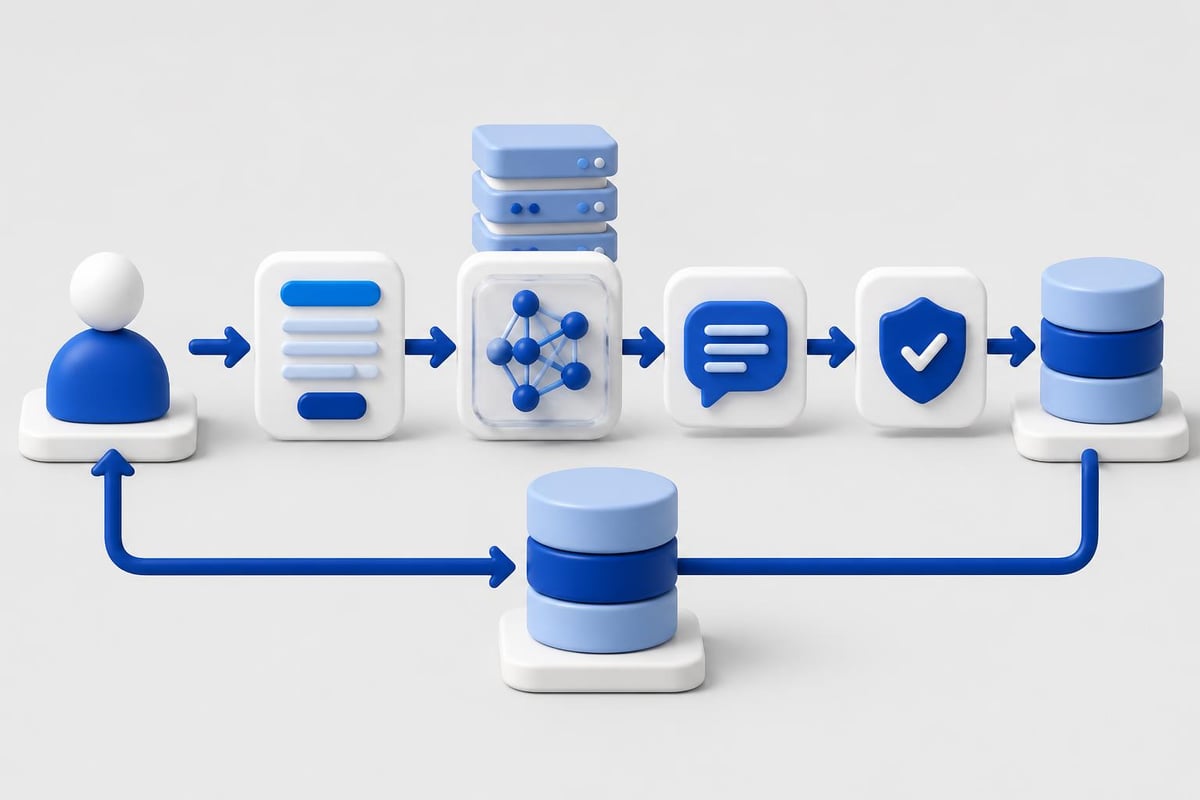
A typical integration for code analysis might look like:
import anthropic
import json
from tenacity import retry, stop_after_attempt, wait_exponential

@retry(stop=stop_after_attempt(3), wait=wait_exponential(multiplier=1, min=4, max=10))
def analyze_code(code_snippet, file_type):
    client = anthropic.Anthropic(api_key=os.environ.get("ANTHROPIC_API_KEY"))

    message = client.messages.create(
        model="claude-3-5-sonnet-20241022",
        max_tokens=1024,
        system="You are a code review assistant...",
        messages=[{
            "role": "user",
            "content": f"Analyze this {file_type} code:nn{code_snippet}"
        }]
    )

    # Parse and validate response
    result = json.loads(message.content[0].text)
    return validate_analysis(result)
This handles retries automatically, uses environment variables for API keys, and validates outputs before returning them to application logic.
For developers looking to build production-ready AI features across multiple use cases, the AI Developer Certification (Mammoth Club) teaches practical integration patterns, prompt engineering workflows, and deployment strategies through hands-on projects.

Current State and Performance Benchmarks
Understanding modern artificial intelligence performance requires looking beyond marketing claims to actual benchmarks and quantified capabilities.
Language Model Capabilities
The Artificial Intelligence Index Report 2024 provides comprehensive performance data across tasks. Modern language models exceed human baseline performance on many narrow tasks while still struggling with others.
Strong performance areas:
- Code generation for common patterns in popular languages
- Text summarization and extraction tasks
- Translation between high-resource language pairs
- Question answering from provided context
- Classification and sentiment analysis
Weaker performance areas:
- Complex multi-step reasoning requiring intermediate validation
- Mathematical proof generation and verification
- Factual accuracy on long-tail topics outside training data
- Consistency across multiple related generations
- Understanding when they lack knowledge versus hallucinating
For developers, this means understanding which tasks you can automate reliably versus which need human review. Code generation works well for boilerplate and common patterns. It works poorly for novel algorithms or systems requiring deep domain expertise.
| Task Category | Accuracy Range | Latency (p95) | Cost per 1K Tokens | Production Readiness |
|---|---|---|---|---|
| Code completion | 65-85% | 200-500ms | $0.002-0.010 | High with validation |
| Documentation generation | 75-90% | 1-3s | $0.005-0.020 | High |
| Bug detection | 40-60% | 2-5s | $0.010-0.030 | Medium, needs review |
| Test generation | 70-85% | 1-4s | $0.005-0.025 | High with execution |
These metrics come from real-world usage patterns across multiple providers. Your actual results will vary based on prompt quality, model selection, and task specificity.
Vision and Multimodal Models
Modern artificial intelligence extends beyond text. Vision models classify images, detect objects, generate captions, and answer questions about visual content. Multimodal models like GPT-4V combine these capabilities.
Practical applications for developers include:
- UI screenshot analysis for automated testing
- Diagram and chart data extraction
- Code screenshot to executable code conversion
- Visual bug reporting with automatic environment detection
- Design-to-code generation from mockups
The accuracy depends heavily on image quality and task complexity. Simple classification tasks (identifying UI elements) work reliably. Complex reasoning tasks (understanding why a UI is confusing) remain challenging.
Architecture and Integration Considerations
Building production systems with modern artificial intelligence requires thinking about reliability, cost, and user experience differently than traditional APIs.
Managing Non-Determinism
Model outputs vary between requests even with identical inputs. Temperature settings control randomness, but zero temperature doesn't guarantee identical outputs. This impacts caching, testing, and reproducibility.
Strategies to manage this:
- Seed parameter support when available for reproducible generation
- Voting mechanisms running multiple generations and selecting the most common result
- Confidence scoring using model log probabilities to filter uncertain outputs
- Validation layers checking outputs against business rules before accepting them
Testing becomes probabilistic. Instead of asserting exact output matches, you test for properties: valid JSON structure, required fields present, values within expected ranges, outputs aligned with intent.
Cost Optimization
Token-based pricing makes modern artificial intelligence costs variable and potentially unbounded. A single malformed request could consume thousands of tokens in errors.
Cost control mechanisms:
- Set maximum token limits per request and per user
- Cache responses for repeated queries using semantic similarity
- Use smaller models for simple tasks, larger models only when necessary
- Implement rate limiting and quotas at the user level
- Monitor token usage and set up alerts for anomalies
Pre-processing can reduce costs significantly. Practical AI implementation often means extracting relevant content before sending it to models rather than dumping entire documents into prompts.
Consider a documentation Q&A system. Instead of sending full documentation to the model each time, use embeddings to find relevant sections, then send only those sections as context. This reduces tokens per request by 80-90% while maintaining answer quality.
Security and Safety
Modern artificial intelligence introduces new attack vectors. Prompt injection attempts to override system instructions. Data leakage can occur when models memorize training data. Generated code might contain vulnerabilities.
Essential security practices:
- Separate user input from system instructions clearly in API calls
- Validate and sanitize generated code before execution
- Never execute model-generated commands without review
- Rate limit to prevent abuse and cost attacks
- Log prompts and responses for security auditing
- Use content filtering APIs to block inappropriate outputs
The NIST AI Risk Management Framework provides comprehensive guidance on AI system security. For production systems, treating model outputs as untrusted user input and validating accordingly prevents most issues.
Emerging Patterns and Future Direction
Modern artificial intelligence continues evolving rapidly. Understanding emerging patterns helps you build systems that remain relevant as capabilities improve.
Agent-Based Architectures
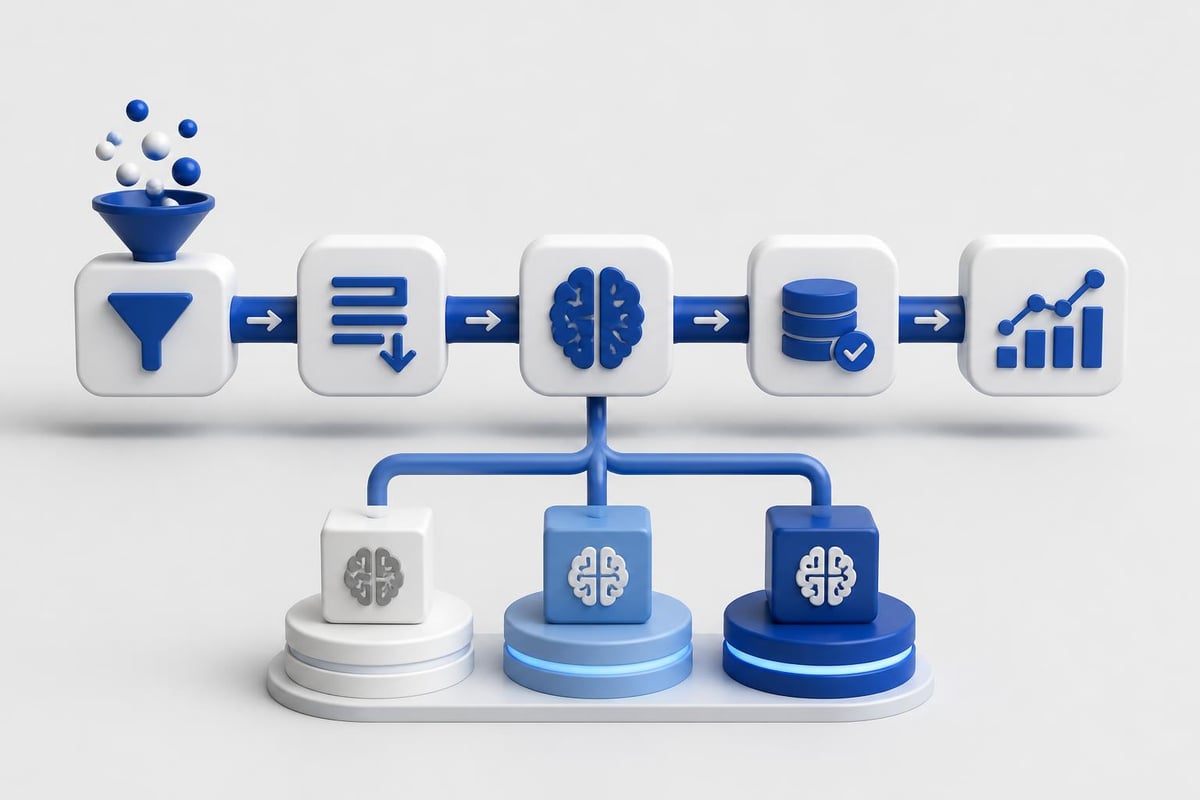
Rather than single API calls, agent patterns chain multiple model interactions with tool use. An agent might:
- Receive a user request to analyze a codebase
- Call file system APIs to list relevant files
- Read selected files based on the request
- Generate analysis using code content as context
- Store results in a database
- Format findings for the user
This pattern appears in coding assistants, research tools, and automation platforms. The agent makes decisions about which tools to use and when, rather than following a fixed workflow.
Implementing agents requires careful thought about:
- Termination conditions so agents don't run indefinitely
- Budget limits on total API calls and tokens per task
- Tool safety ensuring agents can't access dangerous operations
- Observability tracking agent reasoning and decision paths
Research from institutions like Berkeley’s AI lab explores theoretical foundations while practical implementations focus on reliability and cost control.
Specialized Models and Fine-Tuning
While general-purpose models handle many tasks, specialized models often perform better and cost less for specific domains. Fine-tuning creates these specialized models from base models using domain-specific data.
When to fine-tune versus use prompts:
| Scenario | Use Prompting | Fine-Tune a Model |
|---|---|---|
| Task requires specific tone or format | ✓ | ✓✓ |
| Limited examples available (< 100) | ✓✓ | ✗ |
| High request volume on same task | ✓ | ✓✓ |
| Latency critical (< 200ms) | ✗ | ✓✓ |
| Adapting to proprietary terminology | ✓ | ✓✓ |
| Budget sensitive (millions of requests) | ✓ | ✓✓ |
Fine-tuning requires more upfront investment but can reduce per-request costs by 50-90% for high-volume use cases. It also allows using smaller, faster models for tasks that would otherwise require large models.
Retrieval-Augmented Generation
RAG architectures combine language models with external knowledge bases. Instead of relying solely on training data, the system retrieves relevant information and includes it in prompts.
A RAG system for artificial intelligence software development might:
- Convert user questions into embeddings
- Search a vector database of documentation and code examples
- Retrieve the top 5 most relevant chunks
- Include retrieved content in the prompt to the language model
- Generate an answer grounded in actual documentation
This pattern reduces hallucination, keeps information current without retraining, and provides citations for generated answers. The tradeoff is increased complexity: you now manage both a vector database and model API calls.
Implementation typically uses:
- Vector databases like Pinecone, Weaviate, or Qdrant for similarity search
- Embedding models to convert text into vectors (OpenAI embeddings, sentence-transformers)
- Chunking strategies to split documents into searchable units
- Reranking to improve retrieval quality beyond simple similarity
Ethical and Societal Considerations
Building with modern artificial intelligence carries responsibilities beyond technical implementation. Recent discussions, including perspectives on AI’s societal impact, emphasize the need for thoughtful development.
Bias and Fairness
Models trained on internet-scale data inherit biases present in that data. Code generation models might suggest outdated patterns because older code dominates training sets. Language models might reflect demographic biases in their outputs.
Mitigation strategies include:
- Testing outputs across diverse inputs representing different user groups
- Using multiple models and comparing outputs for consistency
- Implementing human review for high-stakes decisions
- Providing transparency about AI use in your applications
- Allowing users to report problematic outputs
Research on trustworthy AI practices provides frameworks for evaluating fairness in deployed systems. For developers, this means including fairness testing in your CI/CD pipeline alongside functional tests.
Healthcare and High-Stakes Applications
Modern artificial intelligence in domains like healthcare requires additional scrutiny. The exploration of AI in health care highlights both potential and risks.
For developers building tools that might impact health, safety, or legal outcomes:
- Understand regulatory requirements in your jurisdiction
- Implement explicit confidence thresholds for automated decisions
- Provide clear explanations of AI involvement to end users
- Maintain audit logs of all AI-generated recommendations
- Never fully automate high-stakes decisions without human oversight
The technical implementation matters less than the governance framework around it. A perfectly accurate model deployed without proper safeguards creates more risk than a less accurate model with appropriate human review.
Environmental Impact
Training large models consumes significant energy. While most developers use pre-trained models via API, understanding environmental impact influences model selection and optimization strategies.
Reduce environmental footprint by:
- Choosing appropriately sized models (don't use GPT-4 when GPT-3.5 suffices)
- Implementing aggressive caching to avoid redundant requests
- Batching requests when real-time responses aren't required
- Using providers that commit to renewable energy
For AI-based projects, environmental considerations increasingly factor into technical decisions alongside cost and performance.
Building Production-Ready AI Applications
Moving from prototype to production with modern artificial intelligence requires attention to reliability, observability, and user experience.
Monitoring and Observability
Traditional monitoring (uptime, latency, error rates) captures only part of the picture. AI-specific metrics matter:
- Output quality scores measuring coherence, relevance, and correctness
- Token usage per request and total monthly spend
- Prompt performance tracking which prompt versions produce better results
- User satisfaction through explicit feedback or implicit signals
- Failure modes categorizing why requests fail or produce poor outputs
Implement logging that captures enough context to reproduce issues. Store the full prompt, model parameters, and response for a sample of requests. When users report problems, this context lets you debug quickly.
Graceful Degradation
Modern artificial intelligence services occasionally fail. Rate limits, outages, and capacity issues happen. Design systems that handle these gracefully:
class AIService:
    def __init__(self, primary_provider, fallback_provider=None):
        self.primary = primary_provider
        self.fallback = fallback_provider

    async def generate(self, prompt, **kwargs):
        try:
            return await self.primary.generate(prompt, **kwargs)
        except RateLimitError:
            if self.fallback:
                return await self.fallback.generate(prompt, **kwargs)
            return self.cached_response(prompt)
        except ServiceUnavailable:
            return self.degrade_gracefully()

    def degrade_gracefully(self):
        # Return pre-generated response or inform user
        return {"status": "unavailable", "message": "AI service temporarily unavailable"}
This pattern allows switching providers, using cached responses, or informing users when AI features are unavailable rather than breaking the entire application.
User Experience Patterns
AI-powered features feel different than traditional software. Users need to understand what's happening and have confidence in outputs.
Effective UX patterns:
- Show loading states that indicate AI is working (not just generic spinners)
- Stream responses for long-form generation so users see progress
- Provide confidence indicators when available
- Allow users to regenerate or refine outputs easily
- Make AI involvement explicit rather than pretending outputs are deterministic
- Include feedback mechanisms to improve future responses
The goal is setting appropriate expectations. Users tolerate occasional imperfect outputs when they understand AI limitations. They lose trust quickly when systems fail silently or hide AI involvement.
Modern artificial intelligence has shifted from research curiosity to production tool, and developers who understand practical implementation gain a significant advantage. The focus moves from theoretical understanding to integration skills: prompt engineering, API reliability, cost optimization, and building features users trust. AI Code Central provides the practical tutorials, API guides, and real-world projects you need to build, ship, and scale AI-powered applications using modern tools and workflows. Start integrating AI into your production software today.