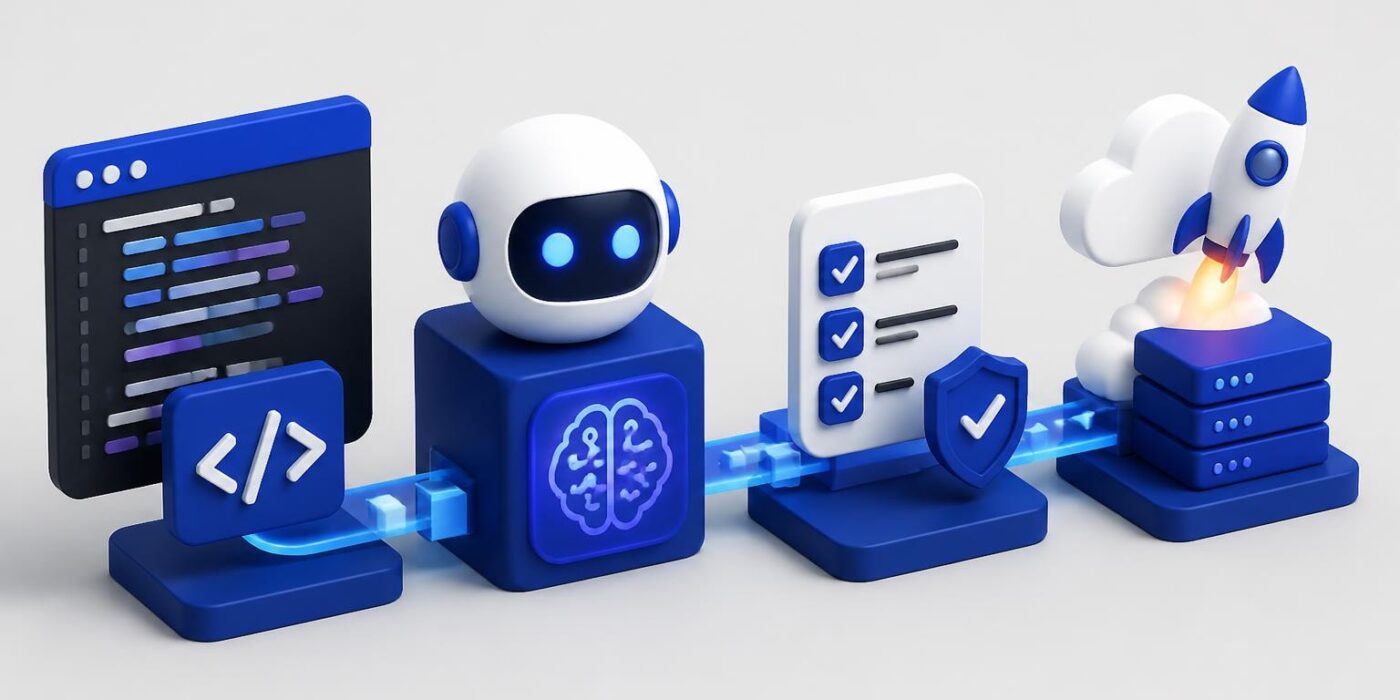
AI in coding has moved from experimental to essential for developers shipping software in 2026. The integration of large language models into development environments changes how we write, test, and deploy code. This isn't about replacing developers – it's about augmenting capabilities, automating repetitive tasks, and accelerating delivery cycles. Understanding how to leverage AI effectively separates developers who ship fast from those who fall behind.
How AI in Coding Actually Works
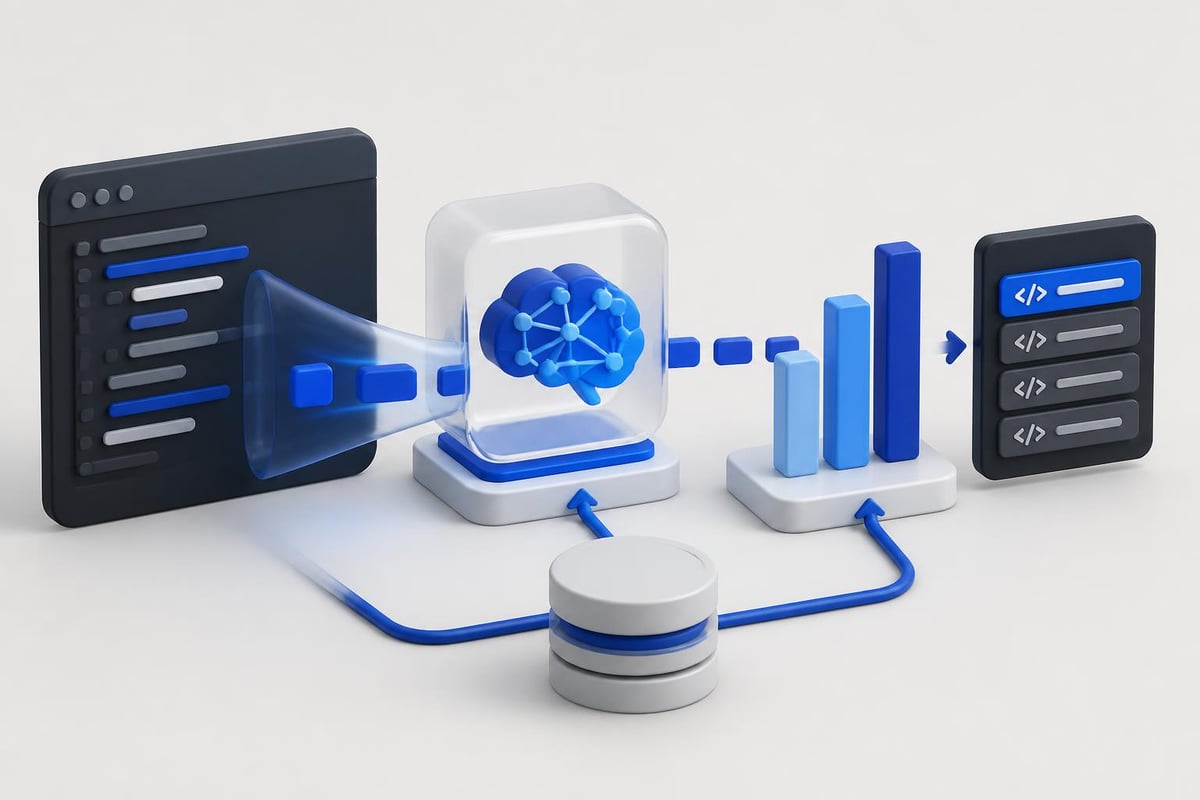
Modern AI coding tools operate on transformer-based language models trained on billions of lines of code. These models understand syntax, patterns, and context across multiple programming languages. When you write a comment or partial function, the AI predicts what comes next based on probability distributions learned from training data.
The process involves three key steps:
- Context analysis – The model reads surrounding code, comments, and file structure
- Token prediction – It generates the most likely next tokens (words, symbols, operators)
- Ranking and filtering – Multiple suggestions are ranked by confidence scores
API Integration Patterns
Implementing AI in coding through APIs follows specific patterns. The OpenAI Codex API, GitHub Copilot API, and similar services expose endpoints that accept code context and return completions.
import openai

def generate_code_completion(prompt, context):
    response = openai.ChatCompletion.create(
        model="gpt-4",
        messages=[
            {"role": "system", "content": "You are a coding assistant."},
            {"role": "user", "content": f"Context: {context}nnComplete: {prompt}"}
        ],
        temperature=0.2,
        max_tokens=500
    )
    return response.choices[0].message.content
Setting temperature lower (0.1-0.3) produces more deterministic, predictable code. Higher values (0.7-1.0) generate creative solutions but risk syntax errors. For production code generation, stick with temperatures below 0.3.
Practical Applications for Production Systems
AI in coding extends beyond autocomplete. The real value emerges when integrating AI into existing development workflows that improve velocity without sacrificing quality.
Code Review Automation
AI models can scan pull requests, identify bugs, and suggest improvements before human review. This catches common issues like SQL injection vulnerabilities, race conditions, or performance bottlenecks.
| Review Type | AI Detection Rate | False Positive Rate | Human Review Time Saved |
|---|---|---|---|
| Security vulnerabilities | 87% | 12% | 40% |
| Logic errors | 72% | 18% | 30% |
| Style violations | 95% | 5% | 60% |
| Performance issues | 68% | 22% | 25% |
However, AI models can’t fully understand security, which means human oversight remains critical for production systems.
Test Generation
Writing unit tests consumes significant development time. AI in coding can generate test cases by analyzing function signatures, input types, and edge cases.
// Original function
function calculateDiscount(price, userType, quantity) {
    if (userType === 'premium' && quantity > 10) {
        return price * 0.8;
    } else if (quantity > 5) {
        return price * 0.9;
    }
    return price;
}

// AI-generated tests
describe('calculateDiscount', () => {
    test('applies 20% discount for premium users with 11+ items', () => {
        expect(calculateDiscount(100, 'premium', 11)).toBe(80);
    });

    test('applies 10% discount for any user with 6-10 items', () => {
        expect(calculateDiscount(100, 'standard', 7)).toBe(90);
    });

    test('applies no discount for small orders', () => {
        expect(calculateDiscount(100, 'standard', 3)).toBe(100);
    });
});
The AI analyzes conditional branches and generates tests covering each path. This works best for pure functions with clear input/output relationships.
Building AI-Powered Development Tools
Creating custom AI coding assistants requires understanding model selection, prompt engineering, and context management. The goal is building tools that fit specific team workflows rather than generic solutions.
Model Selection Criteria
Different models excel at different tasks. GPT-4 handles complex logic and multi-file refactoring. Codex specializes in code completion. Claude excels at documentation generation.
- GPT-4 – Complex algorithms, architectural decisions, cross-file refactoring
- Codex – Real-time autocomplete, snippet generation, function completion
- Claude – Documentation, code explanations, security analysis
- Code Llama – Open-source alternative for on-premise deployment
For developers looking to build production-ready AI features, the AI Developer Certification program covers practical integration of these models into real applications, including prompt engineering patterns and backend workflows that ship.

Prompt Engineering for Code Generation
Effective prompts include context, constraints, and expected output format. Vague prompts produce generic code. Specific prompts with examples generate production-ready implementations.
Weak prompt:
"Write a function to process user data"
Strong prompt:
"Write a TypeScript function that validates user registration data. Accept email (string), password (string), and age (number). Return {valid: boolean, errors: string[]}. Email must match RFC 5322. Password requires 8+ characters with uppercase, lowercase, and number. Age must be 18+."
The strong prompt specifies language, input parameters with types, output structure, and validation rules. This eliminates ambiguity and produces usable code.

Integration Strategies for Existing Codebases
Adding AI in coding to established projects requires careful planning. You're not rewriting everything – you're augmenting specific workflows where AI provides clear ROI.
Incremental Adoption Path
Start with low-risk, high-value areas:
- Documentation generation – Convert code comments to full API docs
- Test expansion – Add test cases to increase coverage
- Refactoring assistance – Modernize legacy code patterns
- Code review augmentation – Pre-screen PRs before human review
- Feature scaffolding – Generate boilerplate for new features
Each step builds confidence and demonstrates value before expanding AI usage. AWS explains AI coding as a productivity multiplier rather than a replacement for developer judgment.
Context Window Management
AI models have token limits (4K to 128K depending on model). Large codebases exceed these limits. Effective integration requires smart context selection.
def build_context_for_ai(file_path, surrounding_files=3):
    context = {
        'current_file': read_file(file_path),
        'imports': extract_imports(file_path),
        'related_files': find_related_files(file_path, limit=surrounding_files),
        'project_structure': get_directory_tree(max_depth=2)
    }
    return optimize_token_usage(context)
Include only relevant context: the current file, imported modules, and directly related files. Summarize project structure rather than including full directory listings.
Real-World Performance and Limitations
AI in coding delivers measurable improvements but comes with constraints. Understanding both helps set realistic expectations and avoid common pitfalls.
Measured Productivity Gains
Studies from IBM on AI in software development show quantifiable improvements across development phases:
| Development Phase | Average Time Reduction | Quality Improvement | Developer Satisfaction |
|---|---|---|---|
| Initial coding | 35-45% | Neutral | +40% |
| Debugging | 20-30% | +15% | +25% |
| Testing | 40-50% | +20% | +35% |
| Documentation | 60-70% | +30% | +45% |
| Code review | 25-35% | +10% | +30% |
Documentation sees the highest gains because AI excels at structured, repetitive writing. Initial coding shows strong time savings but requires careful review for logic errors.
Common Failure Modes
AI coding tools fail in predictable ways:
- Hallucinated APIs – Generating function calls to libraries that don't exist
- Outdated patterns – Suggesting deprecated methods or obsolete syntax
- Context confusion – Mixing up variables or functions with similar names
- Security oversights – Missing input validation or authentication checks
Always validate AI-generated code. Run tests, perform security scans, and review logic before merging. The vibe coding trend shows non-developers creating apps, but production systems require deeper validation.
Advanced Techniques for Expert Developers
Beyond basic autocomplete, advanced AI in coding involves fine-tuning models, building custom agents, and creating development assistants tailored to specific domains.
Fine-Tuning for Domain-Specific Code
Generic models understand common patterns but struggle with proprietary frameworks or domain-specific languages. Fine-tuning adapts models to your codebase.
The process requires:
- Dataset preparation – Extract 10,000+ code samples from your repository
- Preprocessing – Tokenize and format for model training
- Training – Fine-tune base model on your data
- Evaluation – Test on held-out samples from your codebase
- Deployment – Host fine-tuned model via API
Fine-tuning a Code Llama model on your internal codebase can increase suggestion accuracy by 30-50% for project-specific patterns. This makes sense for large teams with unique architectures.
Building Multi-Agent Coding Systems
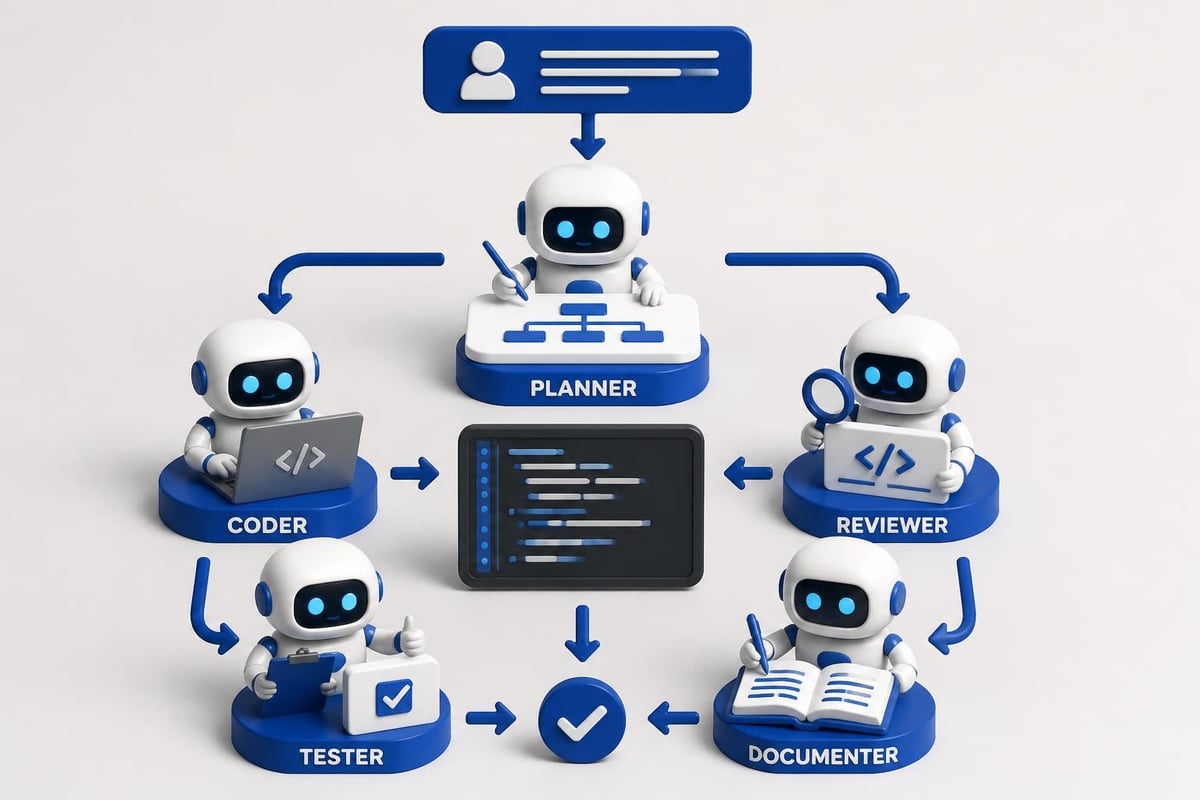
Instead of single AI completions, multi-agent systems decompose tasks across specialized agents:
- Planner agent – Breaks feature requests into subtasks
- Coder agent – Implements each subtask
- Reviewer agent – Checks code quality and security
- Tester agent – Generates and runs test cases
- Documenter agent – Creates API documentation
Each agent uses different prompts and temperature settings optimized for its role. The planner uses higher temperature (0.7) for creative problem decomposition. The coder uses lower temperature (0.2) for precise implementation.
Measuring ROI on AI Coding Investments
Quantifying AI in coding impact requires tracking specific metrics before and after implementation. Focus on measurable outcomes rather than subjective assessments.
Key Performance Indicators
Track these metrics weekly:
- Pull requests per developer – Should increase 20-40%
- Time from commit to merge – Should decrease 25-35%
- Bug density – Bugs per 1000 lines, should improve 10-15%
- Test coverage – Should increase 15-25%
- Documentation coverage – Should increase 30-50%
Compare rolling 30-day averages before and after AI tool adoption. Control for team size changes and project complexity shifts.
Cost-Benefit Analysis
Calculate monthly cost per developer:
Monthly API costs: $50-150 per developer
Tool subscriptions: $10-50 per developer
Training time: 8-16 hours per developer (one-time)
Maintenance overhead: 2-4 hours per month team-wide

Total first month: $260-450 per developer
Ongoing monthly: $60-200 per developer

Time saved: 10-15 hours per developer per month
Value at $100/hour: $1000-1500 per developer per month

Net benefit: $800-1250 per developer per month
ROI becomes positive within the first month for most teams. Larger teams see bigger absolute savings due to shared infrastructure costs.
Security and Compliance Considerations
AI in coding introduces new security vectors. Models trained on public repositories might suggest code containing vulnerabilities or licensing issues.
Code Provenance Tracking
Implement systems that track AI-generated code separately:
def log_ai_suggestion(code_snippet, model_used, confidence_score):
    metadata = {
        'timestamp': datetime.now(),
        'model': model_used,
        'confidence': confidence_score,
        'developer': get_current_user(),
        'file': get_current_file(),
        'review_required': confidence_score < 0.85
    }
    store_in_audit_log(code_snippet, metadata)
This creates an audit trail for compliance reviews. If security issues emerge in AI-generated code, you can identify and patch all instances.
License Compliance
AI models trained on open-source repositories might suggest copyrighted code. Implement checks:
- Exact match detection – Flag code matching known open-source snippets
- License compatibility – Verify suggested dependencies match project license
- Attribution requirements – Track when AI suggestions require attribution
Tools like GitHub's duplicate detector can identify when AI suggestions match copyrighted code. Integrate these into CI/CD pipelines.
Future Trajectory and Emerging Patterns
AI in coding continues evolving rapidly. Understanding emerging trends helps developers stay ahead and make informed tool choices.
The shift from code completion to autonomous development is accelerating. IBM’s AI code generation research shows models handling increasingly complex tasks. Current systems generate functions. Next-generation tools will architect entire microservices.
Natural language to full application pipelines are emerging. Tools like Claude Code demonstrate this trajectory. Developers describe requirements in plain English, and AI generates complete applications including frontend, backend, database schemas, and deployment configs.
Expect these developments in 2026-2027:
- Multi-modal coding – AI understanding diagrams, mockups, and verbal descriptions
- Continuous learning – Models that improve from your team's code reviews
- Predictive debugging – AI identifying bugs before code execution
- Automated optimization – AI refactoring for performance without changing behavior
Academic research on AI-based coding explores these frontiers, providing insights into implementation strategies for production systems.
AI in coding transforms how developers build software, offering measurable productivity gains when implemented strategically. The key is starting with high-value, low-risk applications and expanding as you validate ROI. AI Code Central provides the tutorials, API guides, and real-world projects you need to integrate AI into your development workflow effectively. Start building smarter, shipping faster, and staying competitive in today's AI-driven development landscape.