
Building production-ready AI applications requires more than understanding theory. Developers need practical artificial intelligence skill sets that translate directly into shipped features, automated workflows, and integrated systems. The gap between knowing about AI and actually implementing it in real codebases is where most developers struggle. This guide breaks down the essential technical skills, implementation patterns, and hands-on approaches that turn AI knowledge into working software.
Core Technical Foundations for AI Development
Programming proficiency forms the foundation of any artificial intelligence skill set. Python dominates AI development because of its extensive library ecosystem, but the language itself is just the starting point. You need to understand how to structure code for AI workloads, manage dependencies, and handle asynchronous operations when working with API calls.
Essential Programming Patterns
API integration skills separate developers who can ship AI features from those who only read documentation. Every major AI provider (OpenAI, Anthropic, Cohere) exposes functionality through REST APIs. You need to handle authentication, rate limiting, error handling, and response parsing.
Here's what practical API integration looks like:
- Authentication management: Securely storing and rotating API keys using environment variables or secret management services
- Request structuring: Building properly formatted JSON payloads with system prompts, user messages, and parameters
- Response handling: Parsing streamed responses, extracting relevant data, and managing partial completions
- Error recovery: Implementing retry logic with exponential backoff for transient failures
Data manipulation represents another critical artificial intelligence skill. AI models consume and produce data in specific formats. You'll work with JSON extensively, transform structured data into prompts, and parse model outputs back into usable application state.
| Data Operation | Common Use Case | Required Skill |
|---|---|---|
| JSON serialization | Converting objects to API requests | Language-native encoding |
| String templating | Building dynamic prompts | Template engines, f-strings |
| Response parsing | Extracting structured data from text | Regex, JSON parsing, validation |
| Data validation | Ensuring output meets requirements | Schema validation, type checking |
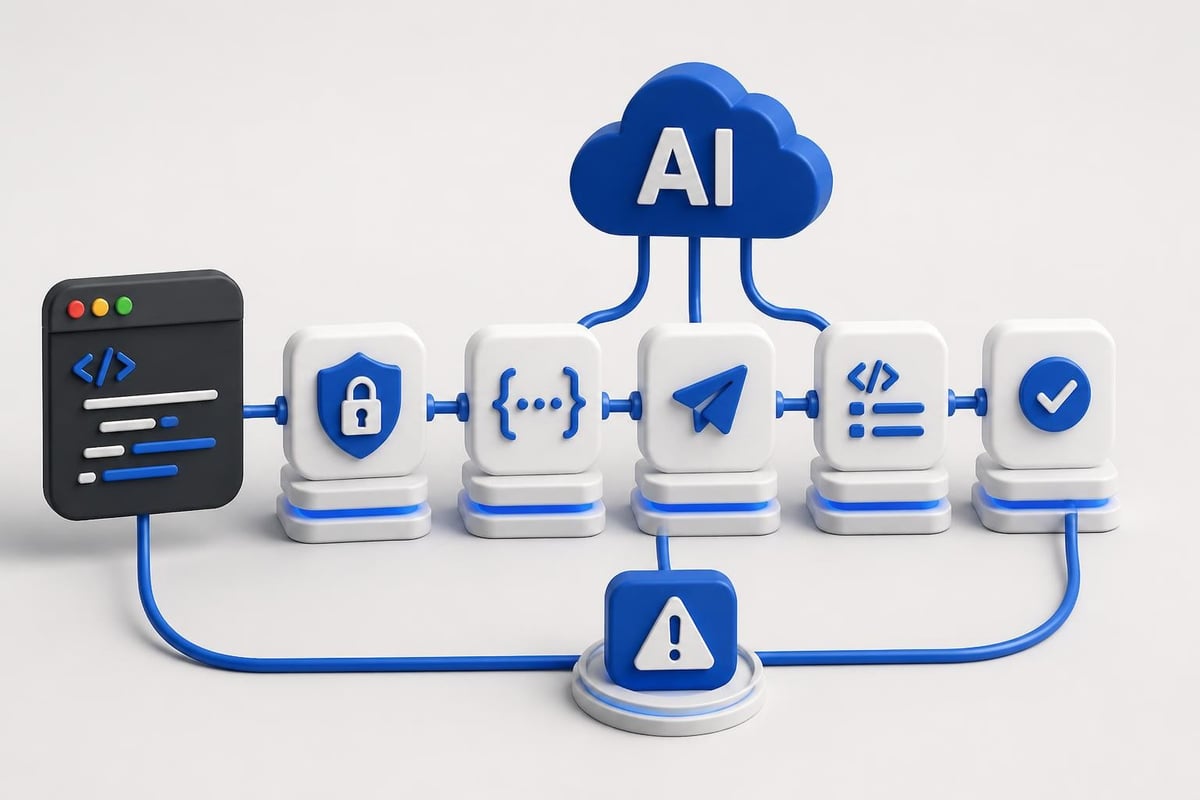
Understanding how to integrate AI into coding workflows means mastering these data transformation patterns. Every AI feature you build will follow this cycle: prepare data, call API, validate response, handle errors.
Prompt Engineering as Production Code
Prompt engineering is not copywriting. It's a programming discipline that requires version control, testing, and systematic optimization. Treating prompts as code changes how you approach AI development entirely.
Building Reliable Prompt Systems
System prompts define behavior boundaries and output formats. They should be deterministic, tested, and versioned like any other code. Store prompts in separate files, use template variables for dynamic content, and maintain a prompt library for your application.
The artificial intelligence skill of prompt engineering includes:
- Defining clear objectives: Specify exactly what the model should produce, including format, length, and constraints
- Providing context efficiently: Include only relevant information that influences the output
- Structuring output requirements: Use JSON schemas, markdown formats, or specific delimiters to make parsing reliable
- Testing edge cases: Identify where prompts fail and iterate on instructions
Few-shot examples transform unreliable AI outputs into consistent results. Instead of hoping the model understands your intent, show it exactly what you want with 2-3 concrete examples. This pattern works across classification, extraction, generation, and transformation tasks.
Version your prompts using Git. Tag releases when prompts go to production. Document what changed and why. This makes debugging easier when model updates affect your application's behavior. According to research on AI skills and job prospects, systematic approaches to AI implementation significantly improve outcomes.
Backend Integration and Workflow Automation
Connecting AI capabilities to existing systems requires solid backend engineering. The artificial intelligence skill of integration means building APIs that wrap AI providers, managing state across async operations, and orchestrating multi-step workflows.
API Design for AI Features
Your application's users shouldn't directly call OpenAI or Claude APIs. Build an abstraction layer that handles:
- Request queuing: Managing concurrent requests without hitting rate limits
- Cost tracking: Logging token usage per request for billing and monitoring
- Caching: Storing responses for identical requests to reduce API calls
- Fallback handling: Switching providers or models when primary services fail
class AIService:
    def __init__(self, provider="openai", model="gpt-4"):
        self.provider = provider
        self.model = model
        self.cache = RequestCache()

    async def complete(self, prompt, max_tokens=500):
        cache_key = hash((prompt, self.model, max_tokens))
        if cached := self.cache.get(cache_key):
            return cached

        response = await self._call_provider(prompt, max_tokens)
        self.cache.set(cache_key, response)
        return response

Asynchronous programming becomes essential when building AI features. API calls take seconds, not milliseconds. Blocking request handlers create terrible user experiences. Use async/await patterns, background job queues, or serverless functions to keep your application responsive.
Orchestrating Multi-Step AI Workflows
Complex AI features rarely involve a single API call. You might extract data from documents, classify content, generate responses, and validate outputs in sequence. Building reliable workflows requires thinking about state management and error boundaries.
Developers building AI software development systems need to handle workflow failures gracefully. If step 3 of a 5-step process fails, can you retry just that step? Do you need to restart from the beginning? How do you track progress?
Workflow patterns to implement:
- Sequential pipelines: Execute steps in order, passing outputs as inputs to the next stage
- Parallel execution: Run independent AI calls concurrently to reduce total latency
- Conditional branching: Route requests to different models or prompts based on input characteristics
- Error compensation: Implement fallback strategies when specific steps fail
Modern developers need to understand these patterns because AI features ship as integrated systems, not isolated experiments. The TechTarget article on in-demand AI skills emphasizes that technical foundations combined with integration capabilities define success.
Testing and Validation Strategies
AI outputs are probabilistic. The same prompt can produce different results across runs. This non-determinism breaks traditional testing approaches. Building artificial intelligence skill in testing means adapting validation strategies for uncertainty.
Assertion Strategies for AI Features
You can't assert exact equality on AI outputs, but you can validate properties:
| Validation Type | What You Test | Implementation |
|---|---|---|
| Format checking | Output matches expected structure | JSON schema validation, regex patterns |
| Content inclusion | Required elements appear in response | Substring matching, keyword detection |
| Length constraints | Response falls within acceptable ranges | Character or token counting |
| Semantic similarity | Output meaning aligns with expectations | Embedding comparison, classification |
Property-based testing works well for AI features. Instead of checking exact outputs, verify that responses satisfy requirements. If you're building a summarization feature, test that summaries are shorter than inputs, contain key entities, and avoid hallucinated facts.
Temperature settings affect output consistency. Set temperature to 0 for deterministic tasks like classification or extraction. Use higher temperatures (0.7-1.0) for creative generation where variety is valuable. Understanding this parameter is a fundamental artificial intelligence skill for controlling model behavior.
Regression testing catches when model updates break your application. Save input-output pairs from production, and periodically re-run them to detect drift. If outputs significantly change after a model update, investigate whether your prompts need adjustment.
Deployment and Production Considerations
Shipping AI features to production introduces operational challenges beyond writing code. The artificial intelligence skill of deployment covers monitoring, cost management, and scaling strategies that keep applications running reliably.
Monitoring and Observability
Track metrics specific to AI operations:
- Latency per provider: Measure response times across OpenAI, Anthropic, and other services
- Token consumption: Monitor usage against budget limits and optimize prompts
- Error rates: Track API failures, timeouts, and invalid responses
- Cost per feature: Calculate spending per user interaction or API endpoint
Logging becomes crucial for debugging AI features. Log the full request context, including prompts, parameters, and raw responses. When users report issues, you need to reproduce exactly what the model received and returned.
Cost optimization requires understanding token economics. Every character in your prompt and response counts toward billing. Reducing system prompt length by 20% can cut costs significantly at scale. The hands-on approach discussed in TechRadar’s article on digital skills emphasizes practical implementation over theoretical knowledge.
Developers who want to deepen these skills and build real AI applications should consider structured learning paths. The AI Developer Certification (Mammoth Club) provides hands-on projects covering prompt engineering, backend integration, and deployment workflows that translate directly into production capabilities.

Scaling Strategies
AI API costs scale linearly with usage. Implement caching aggressively. If 30% of requests are duplicates, caching eliminates that spend immediately. Use Redis or similar in-memory stores for fast lookups.
Rate limiting protects against runaway costs. Set per-user limits on API calls, implement quotas for expensive operations, and queue requests during high-traffic periods. Your application should degrade gracefully when hitting limits, not crash or rack up unexpected bills.
Model Selection and Provider Management
Choosing the right model for each task is an artificial intelligence skill that directly impacts cost and performance. GPT-4 excels at complex reasoning but costs significantly more than GPT-3.5. Claude handles long contexts well. Smaller models work fine for classification.
Decision Framework for Model Selection
Build a decision tree for routing requests:
- Task complexity: Simple tasks (classification, extraction) use smaller models; complex reasoning uses frontier models
- Context length: Long documents or conversations require models with large context windows
- Response time requirements: Real-time features need fast models; batch processing can use slower, cheaper options
- Cost sensitivity: High-volume endpoints justify optimization; low-traffic features prioritize quality over cost
Developers working on AI-based projects need to test models empirically. Run the same prompt across different providers, measure quality and latency, and calculate cost per request. Build benchmarks specific to your use cases.
Provider diversity reduces risk. If OpenAI experiences downtime, can your application fall back to Anthropic? Building provider-agnostic abstractions requires extra work upfront but prevents complete service outages.
| Provider | Strengths | Best Use Cases |
|---|---|---|
| OpenAI | Function calling, structured outputs | API integrations, data extraction |
| Anthropic | Long context, instruction following | Document analysis, complex reasoning |
| Cohere | Embedding quality, classification | Search, semantic similarity |
| Open-source | Cost control, customization | High-volume batch processing |
Security and Compliance Patterns
Production AI features handle user data, API credentials, and potentially sensitive outputs. Security must be built in, not added later. The artificial intelligence skill of secure implementation protects both users and systems.
Input Sanitization and Output Validation
Never pass user input directly to AI models without sanitization. Users can inject malicious prompts that manipulate model behavior. Implement input validation that:
- Strips or escapes special characters that break prompt structure
- Enforces length limits to prevent context overflow
- Filters profanity, personally identifiable information, or sensitive content
- Validates input matches expected formats
Output validation catches when models generate harmful, biased, or incorrect content. Use classification models to screen responses before returning them to users. Implement content filters, fact-checking against known databases, and human review for high-stakes outputs.
API key management separates amateur implementations from production systems. Never hardcode credentials. Use environment variables in development, secret management services in production. Rotate keys periodically. Monitor for unusual usage patterns that might indicate key compromise.
Continuous Learning and Adaptation
The AI landscape changes monthly. New models release, existing APIs evolve, and best practices shift. Developing artificial intelligence skill means committing to ongoing learning and experimentation. The Coursera overview of essential AI skills highlights the importance of adaptability.
Staying Current with AI Development
Build in public: Share projects, code samples, and learnings. Contributing to open AI projects accelerates learning through community feedback and collaboration.
Subscribe to provider changelogs. OpenAI, Anthropic, and others announce model updates, API changes, and new features through official channels. These updates often include performance improvements or cost reductions you can leverage immediately.
Experiment with new models as they release. Allocate time for testing GPT-4's latest version, trying Claude's extended context, or evaluating open-source alternatives. Hands-on experimentation builds intuition faster than reading documentation.
The Tom's Guide article on valuable skills in 2026 emphasizes that AI literacy combined with critical thinking defines competitiveness in modern development roles.
Building Portfolio-Ready AI Projects
Demonstrating artificial intelligence skill requires shipping actual projects, not just completing tutorials. Employers and clients want evidence of implementation experience, problem-solving ability, and production-ready code.
Project Selection Criteria
Choose projects that showcase multiple skills:
- API integration: Connect to at least one major AI provider
- Backend design: Build a RESTful API or webhook system
- Data handling: Process inputs, transform outputs, manage state
- User interface: Create a simple front-end demonstrating the feature
- Deployment: Host on a platform (Vercel, Railway, AWS) with public access
Start with focused applications that solve real problems. A document summarization API is more impressive than a chatbot clone. An automated content classifier demonstrates understanding better than a prompt playground.
Document your projects thoroughly. Include a README explaining the problem, your solution, technical choices, and deployment process. Write about challenges you encountered and how you solved them. This documentation becomes your portfolio and teaching material for others.
Time discusses how workers adapt in the AI era by combining technical AI implementation with uniquely human judgment. Your projects should demonstrate both technical execution and thoughtful problem-solving.
Mastering artificial intelligence skill means building systems that integrate AI capabilities into production software, not just understanding concepts. The technical foundations (API integration, prompt engineering, backend workflows), testing strategies, deployment patterns, and security considerations covered here provide the framework for shipping real AI features. Start experimenting with practical implementations, build portfolio projects, and iterate based on real-world feedback to develop expertise that translates directly into shipped applications. AI Code Central offers hands-on tutorials, API guides, and real-world projects that help developers build production-ready AI features, automate workflows, and stay competitive in modern development.